
- Arrest Records
- Judgments
- Bankruptcies
- DUIs & DWIs
- Felonies
- Warrants
- Jail Records
- Lien Records
- Sex Offenses
- Misdemeanors
- Criminal Records
- Federal Dockets
What are Iowa Court Records?
Iowa ranks 32nd among the most populous states in the United States, with 3.2 million residents. The state's judicial system, which includes a state supreme court, court of appeals, district, and juvenile courts, typically handles more than 650,000 cases a year. To preserve public safety and offer equitable and unbiased answers to common issues, Iowa courts are open to everyone.
Court records in Iowa are considered public records in the state and are accessible to the public upon request. The courts produce and maintain these records, which include complaints in civil cases and indictments in criminal prosecutions. These records include:
Docket Sheets
These contain crucial information on the judges, attorneys of record, and parties. A list of the documents used throughout the trial, together with their summaries, is also provided in the docket sheet.
Judgments and Orders
These records contain the jury or court's verdicts. After the trial, they are signed by the court. They outline the consequences and responsibilities for each party and include the ultimate decision.
Transcripts
These are written descriptions of court proceedings that document the rulings of the judges. They are particularly useful when presenting an appeal request or supporting documentation for a motion.
Evidence
This includes witness statements from both sides of the case at trial and tangible proof found during police investigations.
Court Minutes
These note the start and end of a trial. The names of the witnesses and lawyers are also listed. The court's proceedings, including recesses, testimony, and official statements, are summarized in the minutes.
Pleadings
These are formal written declarations outlining the accusations made by each party to the case. They consist
Briefs
Attorneys use briefs to submit written arguments to the court. They are intended to assist the court in resolving the case's legal disputes.
Most Iowa court records are accessible to anybody who knows the specifics of a case, such as the names of the parties or case numbers. However, there may be exemptions, such as records about children or sensitive information.
Types of Court Cases
Court cases fall into two main categories: criminal and civil. The main differences between these case types are the level of proof needed and the possible consequences. Other minor categories include family and traffic cases.
Civil Cases
The courts can resolve conflicts between individuals and organizations through civil trials. Unlike criminal cases, civil cases do not result in jail time or other serious loss of rights. Rather, they are settled by paying fines, dealing with the root of the dispute, or stopping a particular act. Their goal is to resolve conflicts and provide some sense of justice to the plaintiff.
A civil case often begins when one individual or group (the plaintiff) claims that another individual or group (the defendant) has harmed them. The plaintiff asks the court for redress by filing a complaint and starting a legal action. The plaintiff may seek damages or monetary compensation to make up for their losses or injuries. They might also ask for an injunction, which stops the defendant from doing an offending act.
Civil cases are decided by a jury or a judge. However, both parties can choose to have an out-of-court settlement, which usually involves a financial agreement. In a civil action, there is no legal right to counsel, unlike in criminal cases. Civil parties are required to represent themselves in court or hire legal representation.
Civil attorneys are required to meet a standard of proof known as the "preponderance of the evidence." This implies that the evidence must be more likely to be true than the evidence that contradicts it. Rather than the amount of evidence offered, decisions are made largely on how compelling the provided evidence is, regardless of the quantity.
Criminal Cases
A criminal case is formed when an individual is accused of a crime by a prosecutor working for the government. Criminal cases generally serve as a deterrent to future criminal action. They are meant to rehabilitate or keep offenders away from society. A criminal trial begins with the offender being arrested and charged during an indictment hearing.
Defendants in criminal cases are entitled to a jury trial by their peers. Each jury is hand-picked from a randomly selected pool of district residents, and the judge conducts interviews with each juror to rule out any potential bias. Another option available to defendants is a bench trial, which is a trial without a jury. Unlike in civil matters, defendants in criminal cases are entitled to legal representation.
Jurors in criminal cases must cast unanimous votes to fulfill the standard of "beyond a reasonable doubt". This is because if found guilty of a crime, far harsher punishments could be meted out in a criminal case. A fine, jail time, community service, or a mix of all three could be the punishment in a criminal case.
What Are the Different Courts in Iowa?
Iowa has a unified court system with two appellate courts and a single district court in each of its 99 counties, organized into eight judicial districts and supported by an estimated $224 million in state general fund appropriations for fiscal year 2026.
| Court Level | Court Name | Jurisdiction | Key Functions |
|---|---|---|---|
| Appellate | Supreme Court | Statewide; seven justices | Final appeals, further review of Court of Appeals decisions, court rules and attorney regulation |
| Appellate | Court of Appeals | Appeals assigned by the Supreme Court; nine judges | Hears most appeals and issues final rulings unless further review is granted |
| General Jurisdiction | District Court (District Judges) | Any civil, criminal, probate or juvenile case; one court in every county | Felony trials, divorces, major civil disputes and appeals from magistrates |
| Limited Jurisdiction | District Court (District Associate Judges and Magistrates) | Simple misdemeanors, traffic, infractions, small claims and evictions; associate judges also hear lesser felonies and civil suits up to $10,000 | Traffic and petty offenses, small claims, search warrants and preliminary hearings |
| Limited Jurisdiction | Juvenile and Probate Courts (Associate Judges) | Divisions of the district court for juvenile and probate matters | Delinquency, child welfare, adoptions, wills, trusts, guardianships and conservatorships |
How Many Federal Courts Are In Iowa?
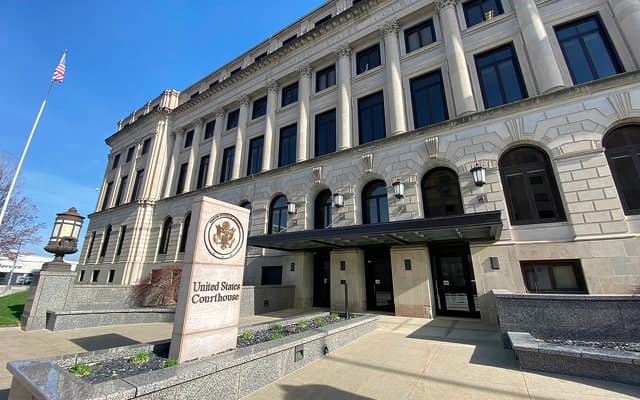
Iowa has two federal courts: the United States District Court for the Northern District of Iowa a and the United States District Court for the Southern District of Iowa. The Northern Court has jurisdiction over four divisions, namely the Western, Central, Eastern, and Cedar Rapids Divisions. There are three court divisions in the Southern District of Iowa, which consists of 47 counties: the Eastern Division's courthouse is in Davenport, the Central Division's is in Des Moines, and the Western Division's is in Council Bluffs.
These courts have limited jurisdiction and handle specific cases such as naturalisation. The U.S. Court of Appeals for the Eighth Circuit is responsible for hearing appeals from these districts.
How Many Court Cases Are Filed Each Year in Iowa?
Iowa's district courts received about 723,500 new filings in 2025, with simple misdemeanors (mostly traffic violations) making up more than 60 percent of the caseload. Clearance rates are estimated at roughly 100 percent.
| Case Type | Annual Filings | % of Total | Common Offense/Subtype | Clearance Rate |
|---|---|---|---|---|
| Traffic | 451,840 | 62.5% | Speeding and other state traffic violations, plus other simple misdemeanors | ~100% |
| Criminal | 82,694 | 11.4% | Felonies, serious and aggravated misdemeanors, probation revocations | ~100% |
| Civil | ~43,965 | ~6.1% | Contract and debt claims, personal injury, real property, mortgage foreclosures | ~100% |
| Small Claims | ~82,700 | ~11.4% | Landlord-tenant disputes, consumer debt, claims of $6,500 or less | ~100% |
| Domestic Relations | ~14,700 | ~2.0% | Divorce, child custody, support and visitation | ~100% |
| Juvenile | 8,641 | 1.2% | Delinquency, child in need of assistance, family in need of assistance | ~100% |
| Other | ~38,968 | ~5.4% | Probate, mental health and substance abuse commitments, county and municipal infractions | ~100% |
| Total | 723,508 | 100.0% | — | ~100% |
How Do I Look Up Court Cases in Iowa?

You can obtain court records in Iowa by reaching out to the custodian at the court where the case was heard and requesting to view the record. During regular business hours, requests can be sent in writing or verbally to the Judicial Branch. Custodians, however, have the right to ask that complicated demands be made in writing. Requests must contain enough information to allow for a reasonable identification of the records being sought. You may use the Iowa Judicial Branch's Court Directory to find the location of the court from which you are seeking a record.
Note that the judicial branch has established different custodians depending on who is making the request, such as the media.
- Media Requests: No matter the type of record, media requests must be sent to the Judicial Branch Communications Director via email.
- District Court Case Records: Request for district court case records must be sent to the county clerk of court office where the case is filed; a directory of district courts is available here
- Iowa Supreme Court and Court of Appeals: Request for case records from the appellate courts must be sent to the Clerk of the Iowa Supreme Court via email.
- Administrative Records: Requests for judicial branch administrative records and judicial branch electronic data must be sent to the State Court Administrator via email.
The records custodian may provide an estimate of fees before the requested records are produced or copied. Also, payment of fees incurred in responding to the records request may be required before the requested records are received or reviewed. Responses to records requests are made as soon as possible, depending on the size and nature of the request.
The Iowa Judicial Branch also provides several online platforms that records seekers can use to find various court records. You can look up records via self-service tools such as the Iowa Courts Online Search Platform and the Iowa Court eFile system.
Number of Active Judges — State & Federal
Iowa's justices and judges are selected through merit nominating commissions and stand for retention, while federal district judges hold lifetime appointments. The counts below combine the state judicial officer totals reported for fiscal year 2025 with sitting federal judges.
| Court | Jurisdiction | Active Judges | Selection Method |
|---|---|---|---|
| Iowa Supreme Court | Statewide appellate | 7 | Governor appoints from State Judicial Nominating Commission list; retention elections; eight-year terms |
| Iowa Court of Appeals | Statewide intermediate appellate | 9 | Governor appoints from State Judicial Nominating Commission list; retention elections; six-year terms |
| District Court — District Judges | General jurisdiction trial court in eight judicial districts | 116 | Governor appoints from a district judicial nominating commission list; retention elections; six-year terms |
| District Court — District Associate and Associate Juvenile Judges | Limited jurisdiction judges handling lesser felonies, misdemeanors, civil suits up to $10,000 and juvenile cases | 86 | Appointed by a district judge from a county commission list; retention elections; six-year terms |
| District Court — Magistrates | Limited jurisdiction judicial officers handling simple misdemeanors, small claims and warrants | 138 | Appointed by county magistrate appointing commissions; four-year terms |
| U.S. District Court, Northern District of Iowa | Federal trial court | 2 | Presidential nomination and Senate confirmation; lifetime appointment |
| U.S. District Court, Southern District of Iowa | Federal trial court | 3 | Presidential nomination and Senate confirmation; lifetime appointment |
| Total Active Judges | — | 361 | — |
What Court Records Are Not Available to the Public in Iowa?
While many court records are available to the public, certain records are exempt. A detailed list of records that are restricted from the public is available in the Restricted Document and Case Type documentation. Some categories of court records that the public cannot access include:
- Adoption
- Criminal cases with an outstanding search and seizure or arrest warrant
- County Attorney Subpoena and Non-testimonial or Investigative Matters cases in investigative filings
- Administrative Search Warrant cases in investigative filings
- Dissolution of Marriage with or without children
- Cases ordered expunged or sealed by the court
- Juvenile delinquency and non-delinquency cases
- Adult and juvenile mental health cases
- Search Warrant
Certain records may be purged provided specific requirements are satisfied. To expunge your record, you must submit a written request to the court requesting an order expunging the record. This implies that the public will no longer have access to these records. It does not, however, imply that the case's record will entirely disappear.
Average Case Processing Time & Clearance Rates
Processing times in Iowa vary by case type, from weeks for traffic and small claims matters to a year or more for contested civil cases. The figures below are estimates.
| Case Type | Court Level | Average Processing Time | Description | Clearance Rate |
|---|---|---|---|---|
| Traffic & Parking | Limited Jurisdiction | ~30–90 days | Most citations are resolved by payment or a short hearing before a magistrate | ~100% |
| Small Claims | Limited Jurisdiction | ~45–90 days | Informal hearing before a magistrate, with a judgment entered shortly afterward | ~100% |
| Misdemeanor Criminal | Limited Jurisdiction | ~3–6 months | Initial appearance, plea negotiations, and a bench or jury trial if not resolved by plea | ~100% |
| Civil Cases | General Jurisdiction | ~9–18 months | Pleadings, discovery and motions, with most cases settled or dismissed before trial | ~100% |
| Domestic Relations | General Jurisdiction | ~4–10 months | Divorce and custody cases resolved by agreement or a bench trial after the mandatory waiting period | ~100% |
| Felony Criminal | General Jurisdiction | ~4–8 months | Preliminary hearing, arraignment, plea or jury trial under the 90-day speedy trial rule | ~100% |